lakeside: health
:::: MENU ::::
Showing posts with label health. Show all posts

Friday, April 27, 2018

mesothelioma attorneys california    
If you or a loved one has worked at a California job site with known asbestos contamination, and if you or your loved one has developed mesothelioma, which is an asbestos related disease, you should contact an experienced mesothelioma attorney and file a claim against the companies that caused the exposure. Your California mesothelioma lawyer can help you gain retribution for all the suffering and pain that you have to go through fighting mesothelioma. Most people who have mesothelioma in California didn’t even know that they had been exposed to asbestos, which is the main causative agent of mesothelioma, and this makes them eligible to file a case against the companies that exposed them to asbestos.
Mesothelioma is a malignant disease of the mesothelium, which is the lining of the inner body cavities. This disease has no cure and its treatment is also very painful and costly. By the time the condition is diagnosed, it is already in its late stages and it becomes even more difficult for the victim to treat it effectively as the disease can remain dormant for decades.

How is one exposed to asbestos in California?

In the state of California, mesothelioma and asbestosis along with lung cancer are the most common diseases caused by asbestos exposure [1]. Asbestos exposure usually occurred to workers during the 1970s and the 1980s when the risks and hazards associated with this mineral were not widely known. Although strict regulations control the usage of asbestos in California, the dangerous mineral is not entirely banned at some places and it is still used in some industrial processes and in some products that are available commercially [2]. If you have worked at any of the work sites mentioned below, you should contact your California mesothelioma attorney as soon as possible and file your case.
Shipyards: California has many shipyards, and asbestos has been abundantly been used in shipyards and naval bases. Over 50% of all cases of asbestos related disease and mesothelioma have been reported due to asbestos contamination while working at shipyards.  Shipyards and ship breaking industries are spread throughout the coastal cities of California. These shipyards and naval bases have used asbestos abundantly in their structure and construction as most of the buildings built here were built before the 1970s.
Asbestos manufacturing facilities: There are also many facilities that have been involved with the manufacturing of this deadly mineral. The people who have been working at these facilities are at the highest risk of asbestos contamination.  There is also the additional hazard of asbestos or asbestos containing materials that are used in the manufacturing of the equipment used in these facilities.
Homes and buildings: California was built on an asbestos boom, and many buildings incorporated this cheap insulation material within their structure. Asbestos is an excellent insulation material as its ability to absorb heat is very high. It is also a very cost effective material so many buildings which include schools and even hospitals used this material in their construction. People in California have been exposed to asbestos in residential buildings as well.
Asbestos contaminated sites in California:
There are many high risk, asbestos contaminated sites in the state of California, here are a few well known sites that have been leading causes of mesothelioma and asbestos related diseases in their workers.  

Tuesday, January 16, 2018

>Mesothelioma Survival Rates
    Survival rates for mesothelioma refer to the amount of time patients with mesothelioma live after a diagnosis. Overall, about 40 percent of mesothelioma patients survive the first year after diagnosis. These rates vary based on many factors: Age, race, gender, cancer stage and mesothelioma type.
Historically, survival rates for mesothelioma are measured in terms of one-year survival. However, many mesothelioma patients are beating the odds and living far beyond median survival rates thanks to advances in treatment.
Additionally, five-year survival for mesothelioma patients has steadily improved since 1999, according to the latest report from the National Cancer Institute’s Surveillance, Epidemiology, and End Results (SEER) Program.
Long-term survivors attribute their success to a multidisciplinary approach to treatment from mesothelioma specialists, alternative medicine, clinical trials and nutritional changes.

Mesothelioma Survival Rate vs. Life Expectancy

While these terms are often used interchangeably, mesothelioma life expectancy and survival rates carry different meanings.
Life expectancy refers to the average age a person is expected to live based on the year they were born, where they were born and other demographic factors. An aggressive cancer, such as mesothelioma, can shorten this average.
Survival rates come into play after a person is diagnosed with cancer or another serious health condition. These rates show the percentage of patients in a study or treatment group who are still alive for a certain period of time following a diagnosis.
Researchers describe the mesothelioma survival rate in several ways — usually six-month and one-year survival, but also the percentage of patients who live two years, three years and five years.
Mesothelioma has no definitive cure and most cases are diagnosed in the latter stages, after tumors have spread — a main reason why survival rates are generally lower compared to other cancers.

Factors that Affect Survival Rate

QUICK FACT

Current five-year survival for mesothelioma patients is around 9 percent, while 67 percent of patients diagnosed with cancer of any other site survive at least five years.
Survival rates for mesothelioma cancer vary by the patient’s age, gender, race and several other factors. The location, stage and cell type of the cancer, as well as your overall health, have the strongest influence on your mesothelioma prognosis.

Age

Overall, older mesothelioma patients have a much lower survival rate than younger ones. More than 55 percent of patients diagnosed before the age of 50 live one year, but less than 30 percent of patients 75 or older live the same amount of time.
This difference is largely because younger patients are eligible for more intensive treatments such as surgery. Older individuals may not be candidates for these procedures because of poor overall health or a high risk of complications.

Mesothelioma One-Year Survival by Age Range

Age RangeSurvival Rate
< 5057.2%
50 – 6451.2%
65 – 7440.9%
75+28.5%
Rates are similar for long-term survival. Patients diagnosed before age 50 have nearly a 25 percent chance of surviving a decade, while that drops sharply — to 5.4 percent — for patients between the ages of 50 and 64.
However, it is rare for someone younger than 50 to be diagnosed with mesothelioma. The average age at diagnosis is 73.
The five-year survival rate for patients diagnosed between ages 65-74 is 6.7 percent. That rate falls to 3.8 percent for those 75 or older.

Gender

Research shows women with mesothelioma experience nearly three-fold better survival rate compared to men. After analyzing mesothelioma cases reported in the National Cancer Institute’s SEER database from 1988 to 2013, researchers found the overall five-year survival rate for men was 7 percent, compared with 15 percent for women.

Mesothelioma Survival Rates by Gender

Gender1 Year2 Years3 Years4 Years5 Years
Males37.6%17.4%10.4%7.7%5.9%
Females45.4%29.3%22.2%18.6%16.0%
Most asbestos exposure occurs in the workplace, particularly in industrial jobs traditionally held by men. That helps explain why men account for the majority of all mesothelioma cases.
When asbestos use was far more pervasive decades ago, the few women who did develop a related illness were usually exposed because they lived near mines or factories — especially those that processed the mineral. Women also found themselves exposed by spouses, family members or friends who worked around asbestos and brought home the tiny fibers on their clothes.

QUICK FACT

From 1999 to 2015, 80 percent of Americans who died from mesothelioma were older than 65, according to the Centers for Disease Control and Prevention.
Although numerous factors contribute to patient survival, women with mesothelioma appear to survive longer than men regardless of age, cancer stage, race or type of treatment. For every age group studied in the SEER program, women fared significantly better than men.
There is currently no conclusive answer as to why, but some researchers believe the improved survival could be explained by hormonal differences between genders. 
Women are also more likely to be diagnosed with peritoneal mesothelioma, which carries a better prognosis compared to the more common pleural type.

Race

Mesothelioma is almost exclusive to white individuals, who make up 95 percent of patients.
This vast difference may be in large part because black and Hispanic individuals are less likely to be diagnosed with any type of cancer, mesothelioma included. Data from SEER shows blacks and Hispanics account for only 8 percent of all cancer diagnoses.

Mesothelioma Survival Rates by Race

Race1 Year2 Years3 Years4 Years5 Years
White*39.7%20.2%12.9%9.8%7.8%
Black*35.2%21.4%16%14.3%12%
*Data includes Hispanics
Although race does not appear to impact mesothelioma survival rate much initially, race becomes a more telling factor as time passes. From three years on, the survival rate of white patients is slightly worse than black patients.
Five-year survival among whites is 7.8 percent, compared with 12 percent for blacks. After 10 years, only 4.4 percent of white patients survive, while 8.2 percent of blacks are alive a decade after diagnosis.
SEER data used to calculate these survival rates includes Hispanics among patients who identify as both black and white. Because mesothelioma is rarer among other races, reliable survival statistics are not available.
According to a 2015 study analyzing 13,734 pleural mesothelioma cases in the SEER database, black patients lived longer than white patients despite being less likely to undergo aggressive surgery. Only 18 percent of black patients in the study had surgery, compared to 24 percent of white patients.
Typically, mesothelioma patients who have surgery survive longer than those who do not.

Cancer Site

There are four types of mesothelioma, and the site where the cancer originates can greatly affect patient survival.

QUICK FACT

Half of peritoneal patients who undergo HIPEC live longer than five years.
Of the two most common mesothelioma types — pleural and peritoneal — survival is significantly better for peritoneal mesothelioma patients. This, however, has not always been the case.
Before the emergence of an advanced peritoneal mesothelioma therapy calledhyperthermic intraperitoneal chemotherapy (HIPEC) that combines cytoreductive surgery and heated chemotherapy, median survival for untreated patients was about six months.
This compares to a median survival of less than 12 months for patients with untreated pleural mesothelioma. In select studies, heated chemotherapy has boosted peritoneal mesothelioma survival to between 40 and 92 months.
According to a 2015 meta-study analyzing 20 years of data from 1992 to 2012, the five-year survival rate for peritoneal mesothelioma patients is more than five-times higher than the rate for pleural patients.

Mesothelioma Survival Rates by Site

PleuralPeritoneal
1 year73%92%
3 years23%74%
5 years12%652%
10 years4.7%39%
Source: “Changing Pattern in Malignant Mesothelioma Survival,” published in the journal Translational Oncology in February 2015.
The remaining two types — pericardial and testicular mesothelioma — when combined, account for less than 2 percent of all mesothelioma cases. Median survival for testicular mesothelioma, the rarest type, is 24 months. About 40 percent of patients die from the disease.
Pericardial mesothelioma, which develops on the lining of the heart, has a median survival ranging from six to 10 months.

Stage of Cancer

The stage of your cancer at diagnosis is a strong predictor of overall survival. Survival is best among people diagnosed with mesothelioma at an early stage, before cancer spread starts to limit treatment options.
Early-stage patients who receive prompt treatment experience improved survival because they are more likely to qualify for surgery and other aggressive treatments associated with better outcomes.

Pleural Mesothelioma Median Survival Rate by Stage

Stage 1Stage 2Stage 3Stage 4
19.3 months11.6 months4.7 months2.7 months
Source: “Malignant Pleural Mesothelioma: A Population-Based Study of Survival,” published in the Journal of Thoracic Oncology in November 2010.
Typically, pleural mesothelioma is not diagnosed until it reaches stage 3 or stage 4, the last stages of development. This can include a larger tumor or extensive cancer spread throughout the body. Later stages of mesothelioma are more difficult to treat effectively, so these patients have worse survival rates.
A late diagnosis is common because it can take 20 to 50 years after asbestos exposure for mesothelioma to develop, and many people don’t experience symptoms until the cancer has already reached an advanced stage.
While there is no established staging system for peritoneal mesothelioma, some researchers have proposed their own systems based on the TNM system, which uses tumor size, lymph node involvement and cancer spread to describe the extent of many types of cancer.
One such novel staging system has three stages based on TNM characteristics and a measure of tumor burden called the peritoneal cancer index (PCI). In a 2011 international study involving 294 peritoneal mesothelioma patients treated with cytoreductive surgery and heated chemotherapy, researchers used this system to describe patient survival.
One-year survival for stage 1 patients was 94 percent, 87 percent for stage 2 and 66 percent for stage 3. The researchers also calculated five-year survival, which was 87 percent for stage 1, 53 percent for stage 2 and 29 percent for stage 3.

Tumor Histology

The histology, or cellular makeup, of a mesothelioma tumor is also an accurate predictor for patient survival. Mesothelioma has three primary cell types: Epithelial, sarcomatoid and biphasic. They differ not only in appearance, but also in behavior.
With a median survival of 12 to 24 months, epithelioid mesothelioma — the most common cell type — has the best prognosis. Epithelioid cells are the least aggressive and respond best to treatment.
Sarcomatoid mesothelioma, on the other hand, has a median survival of six months. Sarcomatoid tumors exhibit more aggressive behavior in terms of cell growth and invasive spread. Biphasic mesothelioma, which has both epithelioid and sarcomatoid features, has a median survival of 12 months.

Median Survival Rate by Tumor Histology

Epithelial19 months
Biphasic13 months
Sarcomatoid8 months
In a large, multi-institutional study that investigated how tumor histology and other factors affect survival, researchers observed similar survival rates. Among more than 3,000 pleural mesothelioma patients, the epithelioid cell type had the best survival rate, with a median survival of 19 months. Sarcomatoid patients experienced a median survival of eight months, the worst outcome of all cell types. Median survival for biphasic patients was 13 months.

Friday, January 12, 2018


Asbestos Exposure Among Navy Veterans

Navy veterans still are paying the price today. The Navy finally stopped filling ships with asbestos in the early ’70s, but those vessels remained in use for many years after production stopped.
Asbestos Exposure Sites in Ships
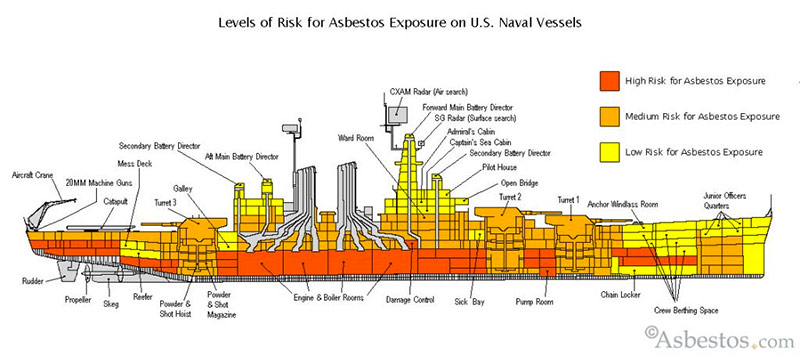
Prior to the U.S. Environmental Protection Agency (EPA) regulating the use of asbestos, shipbuilders were using it in hundreds of applications. Engine rooms, boiler rooms, weapons and ammunition storage rooms – anywhere that needed heat resistance – all had the mineral. It was in the mess halls, the sleeping quarters and navigation rooms, too. Products like cables, gaskets and valves had asbestos. It covered the pipes, pumps, motors, condensers and compressors that helped run a ship. It was in the wall insulation and the floors.
The construction, demolition, repair or renovation of ships – or naval buildings on land – exposed Navy personnel to the microscopic asbestos fibers. As ships aged, asbestos became brittle. Any disturbance, especially in the close quarters of ships and submarines, would make the fibers airborne.Sailors aboard warships often slept in bunks that were below asbestos-covered pipes, forcing them to shake off the dusty material on a regular basis. The Marines that often were transported on the same ships were exposed, too. Personnel who worked below deck on ships were at the highest risk because of where the most heat-resistant asbestos was used, nearest the engine and boiler rooms.

Navy Asbestos Medical Surveillance Program

In the late 1970s, the U.S. Navy launchedthe Asbestos Medical Surveillance Program (AMSP), a comprehensive program that monitors the health of service members and civilian employees of the U.S. Department of the Navy who were exposed to asbestos.
AMSP helps the Navy keep records of exposed members so it can provide regular medical examinations and chest X-rays to detect asbestos-related diseases early on. Early detection is crucial for successfully treating mesothelioma, a deadly cancer that typically takes decades to develop after asbestos exposure.
When an asbestos incident occurs, medical officers can place anyone affected into the AMSP. The medical officer, usually the AMSP manager on a ship or in small facilities, will oversee the initial surveillance exam and the periodic exams that follow.


Once enrolled in the program, Navy service members fill out a questionnaire with information about their work history and any past or current exposures to asbestos. The form also asks a series of questions about lung health to identify early warning signs of asbestos-related disease, such as shortness of breath or a persistent cough.
Next, members visit an occupational health doctor for a physical exam. The doctor evaluates the member’s health and lung function, and then performs an X-ray that may reveal signs of an asbestos-related condition. Another common test, known as spirometry, helps the doctor assess how well the lungs are functioning.
With the results of the questionnaire and initial physical exam, doctors can identify asbestos-related health problems. The doctor documents the results of the exam and tests to use as a reference for future health exams.
If new symptoms appear or existing symptoms worsen, it may indicate an undiagnosed asbestos-related disease. Further testing allows doctors to make the correct diagnosis and promptly get members started with treatment.

Wednesday, January 10, 2018


What Is Asbestos?
Asbestos is a mineral fiber. It can be positively identified only with a special type of microscope. There are several types of asbestos fibers. In the past, asbestos was added to a variety of products to strengthen them and to provide heat insulation and fire resistance.

How Can Asbestos Affect My Health? 
Three of the major health effects associated with asbestos exposure are:


  1. Lung Cancer 
  2. Mesothelioma, a rare form of cancer that is found in the thin lining of the lung, chest and the abdomen and heart 
  3. Asbestosis, a serious progressive, long-term, non-cancer disease of the lungs 

The risk of lung cancer and mesothelioma increases with the number of fibres inhaled.
The risk of lung cancer from inhaling asbestos fibres is also greater if you smoke. People who get asbestosis have usually been exposed to high levels of asbestos for a long time. The symptoms of these diseases do not usually appear until about 10 to 30 years after the first exposure to asbestos.
Most people exposed to small amounts of asbestos, as we all are in our daily lives, do not develop these health problems. However, if disturbed, asbestos material may release asbestos fibres, which can be inhaled into the lungs. The fibres can remain there for a long time, increasing the risk of disease. Asbestos material that would crumble easily if handled, or that has been sawed, scraped, or sanded into a powder, is much more likely to create a health hazard.

READ:MESOTHELIOMA INFORMATION


Where Asbestos Hazards May Be Found Houses?
STEAM PIPES, BOILERS, and FURNACE DUCTS insulated with an asbestos blanket or asbestos paper tape. These materials may release asbestos fibres if damaged, repaired, or removed improperly.

RESILIENT FLOOR TILES (vinyl asbestos, asphalt, and rubber), the backing on VINYL SHEET FLOORING, and ADHESIVES used for installing floor tile. Sanding tiles can release fibers. So may scraping or sanding the backing of sheet flooring during removal.


PATCHING AND JOINT COMPOUNDS for walls and ceilings, and TEXTURED PAINTS. Sanding, scraping, or drilling these surfaces may release asbestos.
SOUNDPROOFING OR DECORATIVE MATERIAL sprayed on walls and ceilings. Loose, crumbly, or water-damaged material may release fibres. So will sanding, drilling, or scraping the material.
RESIDENTIAL CEMENT ROOFING, SHINGLES, and SIDING. These products are not likely to release asbestos fibres unless sawed, drilled, or cut.
ARTIFICIAL ASHES AND EMBERS sold for use in gas-fired fireplaces. Also, other older household products such as FIREPROOF GLOVES, STOVE-TOP PADS, IRONING BOARD COVERS, and certain HAIRDRYERS.
CEMENT SHEET, MILLBOARD, and PAPER used as insulation around furnaces and wood-burning stoves. Repairing or removing appliances may release asbestos fibres. So may cutting, tearing, sanding, drilling, or sawing insulation.
DOOR GASKETS in furnaces, wood stoves, and coal stoves. Worn seals can release asbestos fibers during use.

READ:MESOTHELIOMA LAWSUITS
Asbestos Do's and Don'ts for the Homeowner

  • Do find out whether asbestos materials are present before you have your home remodelled or renovated if it might disturb suspect material. 
  • Do keep activities to a minimum in any areas having damaged material that may contain asbestos. 
  • Do take every precaution to avoid damaging asbestos material. 
  • Do have removal and major repair done by people trained and qualified in handling asbestos. It is highly recommended that sampling and minor repair also be done by asbestos professionals. 
  • Don't dust, sweep, or vacuum debris that may contain asbestos. 
  • Don't saw, sand, scrape, or drill holes in asbestos materials. 
  • Don't use abrasive pads or brushes on power strippers to strip wax from asbestos flooring. Never use a power stripper on a dry floor. 
  • Don't sand or try to level asbestos flooring or its backing. 
  • Don't track material that could contain asbestos through the house. If the material is from a damaged area, or if a large area must be cleaned, call an asbestos professional. 

Monday, January 8, 2018

Donating to Fight Diabetes
As many as 25 million Americans have diabetes. That’s over 8% of the population. South Dakotaalone, one of the least populated states in the Union has a 6% rate of diabetes. Affecting both young and old alike, this disease is life-altering and often life-threatening as well. The American Diabetes Association is working to educate people about diabetes, promoting research, and advocating for affordable treatments for diabetic patients all over the United States. With your car donation to them through Donate a Car, you can help them keep moving forward in the fight against diabetes.
Image result for Donating to Fight Diabetes

Types of Diabetes

There are 3 different types of Diabetes: Type 1, Type 2, and Gestational. Each type has different indicators and risks, and are treated differently by doctors and patients.

Type 1

Type 1 diabetes, formerly known as juvenile diabetes, is a condition where the body doesn’t produce it’s own insulin. Insulin is a hormone that allows your body to absorb the sugars from carbohydrates and use it to provide energy for your body. This condition is typically diagnosed in young adults and children. Type 1 diabetes can be affected by diet, but it can’t be controlled by it. Medication is required to manage this kind of diabetes.

Type 2

Type 2diabetes, or hyperglycaemia, occurs when the body’s blood sugar levels rise above normal. This is caused because the body doesn’t use insulin properly to keep the sugar regulated. This kind of insulin resistance, depending upon the severity of it, can be handled with medication, diet, or a combination of both. This kind of diabetes often becomes apparent in adults.

Gestational

Gestational diabetes is specific to pregnant women. Women who are diagnosed with gestational diabetes don’t necessarily have diabetes before their pregnancy, and won’t usually suffer with it after giving birth. The cause of gestational diabetes isn’t known, but it’s believed that the extra production of hormones that go into growing a foetus interrupt the natural production and absorption of insulin in the mother’s body.

Reduce Your Risk

Unless you have been diagnosed with Type 1 diabetes, there is much you can do to prevent being diagnosed with diabetes in the future. Here are just a few suggestions to help keep you healthy:
  • Maintain a healthy weight
  • Exercise regularly
  • Avoid highly processed sugars and grains, sticking with whole grains as much as possible
  • Reduce sodium consumption
  • Don’t smoke
The efforts you put into staying healthy can save you money, discomfort, and even your life later on.


Ways to Prevent Pancreatic Cancer

In this article you will learn some simple steps to help avoid pancreatic cancer and also some preventive measure to lower the risk. With the help of Hirshberg Foundation for Pancreatic Cancer Research. The goal of the Hirshberg Foundation is to find a cure for pancreatic cancer and to help develop the most advanced treatment options. To donate your car to help them in this cause, click here. Scientists have not found any sure way to prevent pancreatic cancer. Some things just cannot be controlled like race, gender, age and family history. However, there are some things a person can do that may lower their risk.

Image result for In this article you will learn some simple steps to help avoid pancreatic cancer and also some preventive measure to lower the risk. With the help of Hirshberg Foundation for Pancreatic Cancer Research. The goal of the Hirshberg Foundation is to find a cure for pancreatic cancer and to help develop the most advanced treatment options. To donate your car to help them in this cause, click here. Scientists have not found any sure way to prevent pancreatic cancer. Some things just cannot be controlled like race, gender, age and family history. However, there are some things a person can do that may lower their risk.

Things You Can Do To Lower Your Risk of Pancreatic Cancer:

1. Do Not Smoke.

This is the most vital avoidable risk element for pancreatic cancer. If you can quit smoking, it will lower your risk. If you do smoke and would like help quitting, please speak with your physician right away.

2. Maintain a Healthy Weight.

Another way to lower your risk it to get at and stay at a healthy weight. Having regular physical activity and eating a healthy diet are important elements in this effort.

3. Limit Alcohol.

In some studies, heavy drinking of alcohol has been linked to pancreatic cancer. Such conditions as cirrhosis and chronic pancreatitis, which are known to increase the risk of pancreatic cancer, can be promoted by heavy alcohol use.

4. Limit Exposure to Certain Chemicals.

Avoiding exposure in your workplace or other areas to certain chemicals (carcinogens) may also reduce your risk of pancreatic cancer.


Wednesday, January 3, 2018

 Anal sex or anal intercourse is generally the insertion and thrusting of the erect penis into a person's anus, or anus and rectum, for sexual pleasure.While anal sex is commonly associated with male homosexuality, research shows that not all gay males engage in anal sex and that it is not uncommon in heterosexual relationships. Types of anal sex can also be a part of lesbian sexual practices.As with most forms of sexual activity, anal sex participants risk contracting sexually transmitted infections (STIs/STDs). Anal sex is considered a high-risk sexual practice because of the vulnerability of the anus and rectum. The anal and rectal tissues are delicate and do not provide lubrication like the vagina does, so they can easily tear and permit disease transmission, especially if a personal lubricant is not used.


How Risky Is Anal intercourse? A Gynecologist Explains

According to ob-gyn Lauren F. Streicher, MD, director of the Centre for Sexual Medicine and Menopause at the Feinberg School of Medicine at North-western University. There are a few risks involved with anal that women need to know, she says.
Rectal gonorrhoea, anal chlamydia, and HIV are all real risks. According to the United States Centres for Disease Control and Prevention, "anal s*x is the highest-risk s*xual behaviour for HIV infections." But anal s*x is perhaps most likely to transmit the human papillomavirus (HPV). “Very few heterosexual men have HIV, but over half of men have HPV,” says Dr. Streicher. HPV can cause anal warts and anal cancer.
What’s more, she points out, you’re probably not going to get screened for anal STIs at your doctor—unless he or she specifically asks if you’re having anal s*x (unlikely) or you specifically request those tests.
While research suggests anal isn't quite as prevalent as pop culture might suggest—a 2016 study found that just 12.2% of American women had done it within the last three months—there's no question curiosity about the backdoor position has grown.
“Let’s face it; the anus was not made for intercourse. It’s supposed to be a one-way passage,” Dr. Streicher points out. The vagina, on the other hand, “has a thick, elastic, accordion-like lining designed to stretch to accommodate a penis, or a baby.”
Rectal tissue is thinner and doesn’t share the same elasticity, so there’s a greater chance it can tear, says Dr. Streicher, who is the author of Sex Rx. And tearing increases your odds of contracting a sexually transmitted infection.
Then there’s pain, bleeding, and fecal incontinence. “Poop in your pants is not a nice thing to talk about,” says Dr. Streicher. She points to new research from a team at North-western University that found that women who considered anal part of their regular bedroom behavior were more likely to say it changed the consistency of their stools, and report both urinary and fecal inconvenience.
But if you're interested in trying anal sex, or giving it another whirl with your partner, what's the safest way? Use protection no matter what, says Dr. Streicher. “As a gynaecologist, I tell people even if you are in a monogamous relationship; you should always use a condom for anal sex." And if you have vaginal sex after anal, have your partner put on a new condom to protect against the likelihood of a urinary tract infection.

Author’s Take
Sodomy sex is anal sex: its name comes from Sodom and Gomorrah where God destroyed the city because of the homosexuality that was going on there. The anus was not designed for sex, neither is it safe to practice. Even though the Bible doesn’t discuss anal sex between a married couple, from what the Bible does tell us you can see that God intended for the penis to go inside the vagina not the anus.  Married couples shouldn’t be having anal sex. We must not take away God’s natural way of doing things. According to the bible Leviticus 20:13 “‘If a man has sexual relations with a man as one does with a woman, both of them have done what is detestable. They are to be put to death; their blood will be on their own heads. In conclusion say NO to homosexual and say NO to Anal sex.


references
health.com
Wikipedia
Holy bible 

Thursday, December 28, 2017

Mesothelioma information 


Malignant mesothelioma is a unprecedented, asbestos-associated most cancers that typically bureaucracy on the protecting lining of the lungs and stomach. The disease has no definitive remedy, however improvements in conventional treatments along with rising cures are assisting sufferers improve their survival.

Diagram of mesothelioma & other asbestos-related diseases as they form on the lungs

Types of Mesothelioma, Causes & Symptoms

In order to understand mesothelioma and choose the best path to extend survival, you must first grasp some of the basic information about this type of cancer, including its causes, types and symptoms.

Causes
Exposure to asbestos, a naturally occurring mineral once highly regarded for its insulation and fire-retardant properties, is still the overwhelming cause of mesothelioma.
Approximately 75 percent of cases are men who were exposed to asbestos while serving in the military or working certainhigh-risk blue-collar jobs, including construction, firefighting, shipbuilding and industrial work.
Secondhand exposure also occurs when washing the clothes of someone in a high-risk occupation and living near abandoned asbestos mines or areas where asbestos occurs naturally in the environment.

Types
Each type of mesothelioma is classified by the location in the body where it develops. Prognosis, symptoms and treatment options vary by type.
The pleural and peritoneal types of mesothelioma are the most common, while pericardial accounts for just 1 percent of cases. Another rare type known as testicular mesothelioma represents less than 1 percent of all mesotheliomas.

Symptoms

Mesothelioma symptoms do not usually arise until tumors have grown and spread, and they begin to press against the chest wall or abdominal cavity.

COMMON MESOTHELIOMA SYMPTOMS
  1. Dry coughing
  2. Shortness of breath
  3. Respiratory complications
  4. Pain in the chest or abdomen
  5. Fever or night sweats
  6. Pleural effusion (fluid around the lungs)
  7. Fatigue
  8. Weakness in the muscles